The Bolivar Peninsula Opportunity: Why This Market Rewards the Best-Managed Propertie
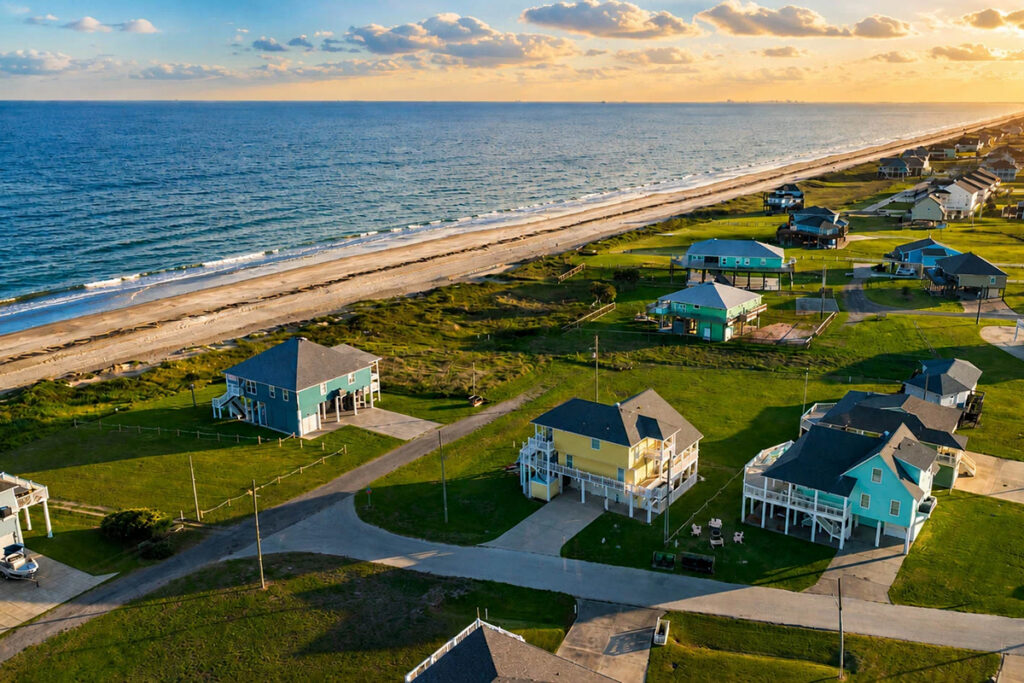
I want to paint a picture of where the vacation rental market is right now — and more specifically, what that means for homeowners on the Bolivar Peninsula and the Texas Gulf Coast.
Because there’s a version of this market story that’s easy to misread. And I want to make sure the homeowners I work with are reading it correctly.
The Macro Picture: Demand Is Outpacing Supply
In the U.S. short-term rental market in 2025, demand grew by approximately 7% year-over-year while supply grew by only 4.7%. That gap — demand growing faster than inventory — is fundamentally good news for homeowners who own well-positioned properties in strong markets.
The global vacation rental market is valued at over $174 billion and is projected to grow at a compound annual rate of more than 10% through 2034. North America alone represents nearly $37 billion of that market. These are not niche numbers. This is a mainstream accommodation category that now captures approximately 23% of total travel accommodation market share in the United States — up from 20% just two years ago.
Families represent nearly 46% of all vacation rental travelers. And the Bolivar Peninsula is, at its core, a family destination — 27 miles of drivable beaches, fishing, birding, local restaurants, community events. The guests who come here are the demographic that books longer, spends more per stay, and comes back year after year.
The Honest Version of 2025–2026
I’m not going to give you a sales-pitch version of this market. Here’s what actually happened.
The fall and winter of 2025 were brutal on the Texas coast. Galveston hotel occupancy was down nearly 50% year-over-year. Broader peninsula demand was the softest it had been in years. Consumer confidence softened. Guests who had been booking casually pulled back.
If you’re a homeowner whose manager sent you an apology email in Q4 2025, you were not alone. That was the quarter.
What separates managers in a market like that is what they did about it. In December 2025, instead of closing out the year quietly, our team built a 2026 offensive plan:
• We launched Flex Protect, a flexible cancellation program we built for two specific reasons: (1) guests book more readily when they have flexibility, which measurably lifts bookings, and (2) we designed it so that flexibility does not come out of your rental income. If you want the exact mechanics, that’s a conversation I’d rather have directly.
• We rolled out a 2026 One-Stop Shop strategy on our direct booking site, concentrating more of our paid, email, and SEO demand on a single owned channel.
• Our in-house revenue team and in-house marketing team — the “Power Couple” — aligned weekly on price, pace, and campaign targeting heading into Q1.
Here’s what happened when the strategy met the market:
• Bookings in January 2026 were up 45% year-over-year across our portfolio — including homes that had previously been managed by Vacasa in their prior January pipeline.
• 78% of those reservations booked at the same rate or higher than the prior year, despite broader market pressure.
• Most of the new bookings were for March and beyond, meaning guests were committing earlier and filling calendars sooner into peak season.
• By March 2026, our portfolio was running ahead of market on occupancy for the quarter — and when the market accelerated, we accelerated faster.
That’s the real arc: soft market + offensive response + durable result. Not a hypothetical. Not a single static RevPAR claim. A real 2025–2026 story that we can walk through in detail with any homeowner who wants to see it.
Why the Texas Gulf Coast Specifically
The demand dynamics here are particularly strong for a few reasons.
Geographic proximity to a massive population base. The Bolivar Peninsula sits within driving distance of the Houston metropolitan area — more than 7 million people. For a family that wants a beach vacation without a flight, there’s no closer option on the Texas coast. That geographic advantage doesn’t go away.
A destination with genuine character. The peninsula isn’t just a beach — it’s an experience. Jeep Weekend, the Texas Crab Festival, Fourth of July on Crystal Beach, the birding trails, the fishing. Guests don’t just book a house here; they book the Bolivar Peninsula. Destinations with that kind of identity generate stronger repeat booking behavior than anonymous beach markets.
Supply is relatively constrained. Unlike some Gulf Coast markets that have seen aggressive inventory growth, the Bolivar Peninsula has maintained a supply-demand balance that supports healthy RevPAR.
The Nuance That Matters: Not All Properties Are Benefiting Equally
Here’s where I want to be specific and honest.
A strong market doesn’t lift all boats equally. The 2025 data is clear: about 80% of bookings or revenue comes from 20% of listings on major platforms. The top 10% of listings capture roughly 70% of all bookings.
What separates the 20% from the 80%? It’s not location alone — within the same market, the gap between a top-managed and an average-managed property is enormous. It comes down to:
• Photo quality and listing presentation that wins the three-second scroll
• Dynamic pricing executed by real humans, not set-and-forget software
• Review scores that drive search ranking — Guest Favorites now appears 40% more often in Airbnb search results
• Multi-channel distribution that puts your home in front of every type of traveler, not just Airbnb users
• A real direct-booking channel so your revenue isn’t dictated by a single platform
• Guest experience that converts one-time visitors into annual repeat guests
A strong market creates opportunity. A strong management partner is what converts opportunity into actual revenue for your specific property.
The Durable Edge
The number I’d most want every homeowner on this coast to internalize is this one: more than 30% of our Texas Coast bookings now come through our own direct booking site. The industry average is under 15%. That’s the single most durable edge a vacation rental company can build, because it insulates your revenue from whatever any OTA does with its algorithm next year. It’s also the number we’re still actively growing.
Where We’re Growing — And Why That Matters for You
In September 2025, we expanded our management portfolio to Surfside Beach — a four-mile stretch of Gulf shoreline just over an hour from Houston. Our properties there are featured at bolivarvacations.com/surfside-beach and managed to the same standards that built our Bolivar reputation.
Through Casago Greater San Antonio, we also manage vacation rental properties across the Texas Hill Country — Canyon Lake, New Braunfels, Wimberley, Dripping Springs, and more.
This growth matters for every homeowner in our program because it means a larger shared guest database, a wider marketing footprint, and more combined brand recognition across the Texas coast. Every new property we add strengthens the marketing power we can bring to yours.
My View on the Next Few Years
The vacation rental industry is professionalizing rapidly. The days when a property could do well just by showing up on Airbnb are behind us in most competitive markets. Guests have higher expectations, platforms have more inventory to rank against, and the gap between professionally operated properties and casually managed ones is widening every season.
That’s not a reason to be pessimistic about your home’s potential. It’s a reason to be intentional about who’s managing it.
The Bolivar Peninsula remains one of the strongest family vacation rental markets on the upper Texas Gulf Coast. The demand is there. The guest profile is strong. The geography is irreplaceable.
What matters now is capturing it.
If you’d like to walk through what the next 12 months could look like for your specific home, I’d genuinely like to have that conversation. Bring your last 12 months of owner statements, and in about 20 minutes I can show you — based on your exact home, your exact comps, and our exact portfolio performance — where the gap is and how to close it.
Felipe Caldeira, CEO & Managing Partner, www.bolivarvacations.com | www.casagosanantonio.com
Recent Posts
All the Comfort of our Homes
Enjoy pools, hot tubs, outdoor kitchens, and more — all steps from the beach.